
WHEN OLDER KIDS GET DISRESPECTFUL:

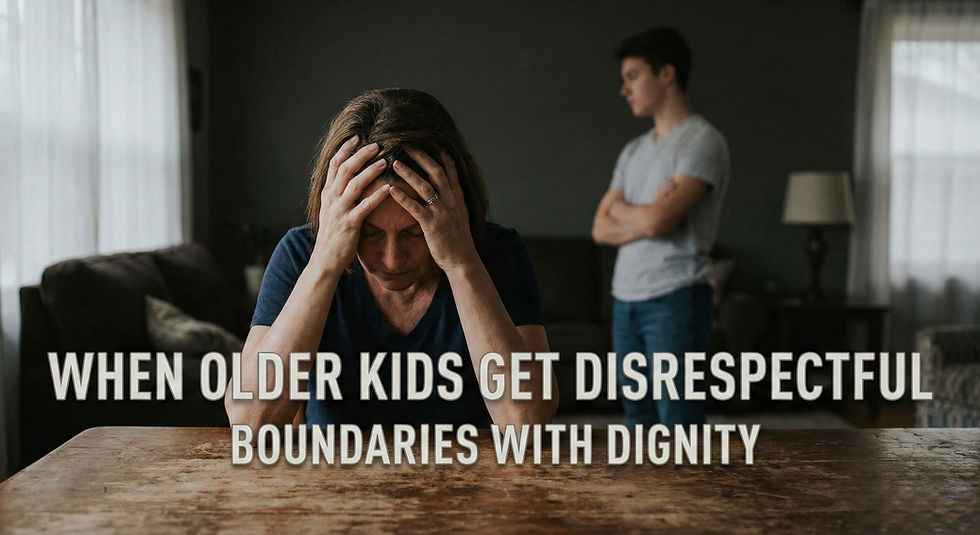
This is one of the hardest crossroads an alienated parent will ever stand at, and there is no answer that feels fully satisfying because the situation itself is deeply unfair.
When an older child disrespects you after being rewarded for it by the other parent, what you are dealing with is not simply “bad behavior.” You are dealing with conditioning. That child has learned that violating your boundaries earns them safety, approval, or protection somewhere else. In that context, disrespect becomes a survival strategy, not a personal attack, even though it feels incredibly personal.
Your response has to start with this truth: you cannot out-argue indoctrination, and you cannot discipline trauma out of a child who has been taught that rejecting you keeps them safe. Getting on their level emotionally, matching their tone, or unloading the raw, ugly truth may feel justified, but it almost always backfires. It confirms the narrative they’ve been fed: that you are unstable, angry, unsafe, or self-serving. Even when the truth is on your side, timing matters. Truth given too early, too forcefully, or without emotional readiness becomes another weapon used against you.
That doesn’t mean you allow abuse.
Readingjusting rights is not about punishment; it’s about boundaries with dignity. An older child does not get unlimited access to you while simultaneously violating your home, your peace, or your humanity. You calmly and consistently communicate what behavior is acceptable in your space, what is not, and what the consequences are — not as retaliation, but as structure. You model what respectful relationship looks like even when they cannot reciprocate it yet. This may mean shortening visits, limiting conversations to neutral topics, or disengaging when disrespect begins. Boundaries are not abandonment. They are containment.
As for telling the truth: there is a difference between truth-telling and emotional dumping. You do not owe your child a courtroom brief of everything their other parent has done to you. That is adult information. What you can do is gently correct false narratives when they arise, without attacking the other parent. Statements like, “I know you’ve been told I didn’t care, and I want you to know that hasn’t been true for me,” keep the door open without pulling the child into a loyalty war. Over time, consistency does what arguments cannot.
And here is the part no one likes to say out loud: loving your child does not require you to be endlessly available for mistreatment. Love can coexist with distance. Love can exist without access. Love can say, “I’m here when you’re ready to treat me with basic respect,” and still be real, deep, and unwavering.
You’ve already done the hardest part — choosing grace in the face of lies, financial abuse, and system-level injustice. The next phase is not about being bigger anymore. It’s about being grounded. Calm. Predictable. Boundaried. Safe.
If your child comes back to you later — and many do — they will not remember how cleverly you argued your case. They will remember that you did not disappear, but you also did not let yourself be destroyed trying to save them.
That balance is not weakness. It is strength.



Comments